


Xeriscaping Fort Myers: Low-Water Landscaping Ideas

Fort Myers gets roughly half its year as a rainforest and the other half as a dry spell. A yard here has to survive both. That is why xeriscaping advice written for Arizona or Colorado sends so many Southwest Florida homeowners in the wrong direction.
This guide covers what low-water landscaping looks like on a Fort Myers lot: how to handle summer storm water, which plants earn their place, what to do with turf, and two layouts you can match to your own yard.
What Xeriscaping Means in Fort Myers
Xeriscaping means water-wise design matched to the site. Denver Water coined the term in the early 1980s for dry Western climates, and its principles still hold up: plan before you plant, improve the soil, choose suitable plants, keep turf practical, irrigate efficiently, mulch, and maintain with purpose. You can read the background on Wikipedia's xeriscaping page.
Fort Myers changes the answer. The area has a heavy summer rainy season and a drier stretch from late fall through spring, so the plant list and the watering calendar both need rewriting. The palette here is Florida-native and Florida-friendly. It does not include desert cactus or gravel-only yards.
The University of Florida's Florida-Friendly Landscaping program frames the same idea with principles like "Right Plant, Right Place" and "Water Efficiently." Use them as a checklist against your own property.
One limit worth stating: xeriscaping does not mean a yard that never needs water or care. It means a yard that needs far less of both once it is established.
Designing for Fort Myers' Wet and Dry Seasons
Water has to be managed in both directions. In summer the problem is too much of it arriving at once, and in the dry months the problem is too little, so a good low-water design plans for each.
Summer Rain: Moving Water Off Planting Beds
Summer storms in Southwest Florida often arrive in heavy bursts that pool in low spots. Many Fort Myers lots also sit on sandy soil that drains quickly, so a single yard can need drainage planning and irrigation planning at the same time.
Grade, swales, and mulch do most of the work. Slope beds gently away from the house, direct runoff toward a swale or a planted low area, and keep a layer of organic mulch of about 2 to 3 inches over the roots so soil holds moisture between rains without sitting soggy.
Before you plant anything, do a quick site check after a hard rain. Note where water stands for more than a day, because some lots sit on poorly drained ground and those spots need wet-tolerant plants or regrading, not hopeful watering. The USDA's Web Soil Survey shows the mapped soil type for your address. For persistent standing water, Cintron's guide to drainage solutions for Florida yards goes further.
Dry Season: Water-Saving Landscaping That Still Looks Full
The 2026-27 dry season is underway now, which makes this the right moment to see how your yard actually behaves without daily rain. Brown edges and wilting beds tell you where the plantings do not match the water they get.
Group plants into hydrozones by water need. Thirsty plants share one irrigation zone near the entry or patio, and drought-tolerant plants share another, so no plant gets drowned to keep its neighbor alive.
Water deeply but less often. A long soak pushes roots down, while short daily sprinkles keep roots shallow and plants dependent on the system.
Before you set any schedule, check the current watering rules from Lee County and your local utility, because restrictions change and apply by address. If your zones are mismatched or the timer is old, irrigation system installation in Fort Myers explains what an upgrade involves.
Drought-Tolerant Landscape Design: Plants That Suit Southwest Florida
The most dependable low-water plants here are Florida natives or proven Florida-friendly species. They handle heat, sandy soil, and periodic wet feet, provided each one is matched to the sun and moisture of its spot. Species named below follow UF/IFAS guidance, and the Fort Myers plant guide has the longer list.
Native Shrubs and Grasses for Sun and Heat
Four plants show up again and again in good Southwest Florida yards:
Muhly grass forms a clump of fine foliage and sends up pink plumes in fall. It wants full sun.
Coontie is a tough, glossy native cycad that suits sun or part shade and needs little once rooted.
Firebush brings orange-red blooms and hummingbirds through the warm months, though a hard freeze can burn it back.
Beautyberry is a native shrub with clusters of purple berries in fall and a loose, informal habit.
Keep these in the drier, sunnier parts of the yard. Wet-tolerant natives belong in the low spots, which the swale example below puts to work.
Plant by site condition, not by looks alone. A muhly grass placed in a spot that floods every August will struggle however drought-tolerant its reputation.
Groundcovers That Replace Turf
Sunshine mimosa and perennial peanut are the two groundcovers most often used to replace turf in Southwest Florida yards. Sunshine mimosa is a low native with pink puffball flowers, and perennial peanut makes a dense green mat with yellow blooms.
Both spread, so both need edging or trimming to stay out of walkways and neighboring beds.
Neither is a play lawn. If the area takes regular foot traffic, use stepping stones or a path through it, or keep a small patch of real turf.
Replacing Turf With Beds, Mulch, and Hardscape
Turf is typically the largest water and mowing load on a residential property. Converting low-use lawn to beds, mulch, and paths cuts both irrigation and upkeep, and the cost is driven mostly by how much area changes.
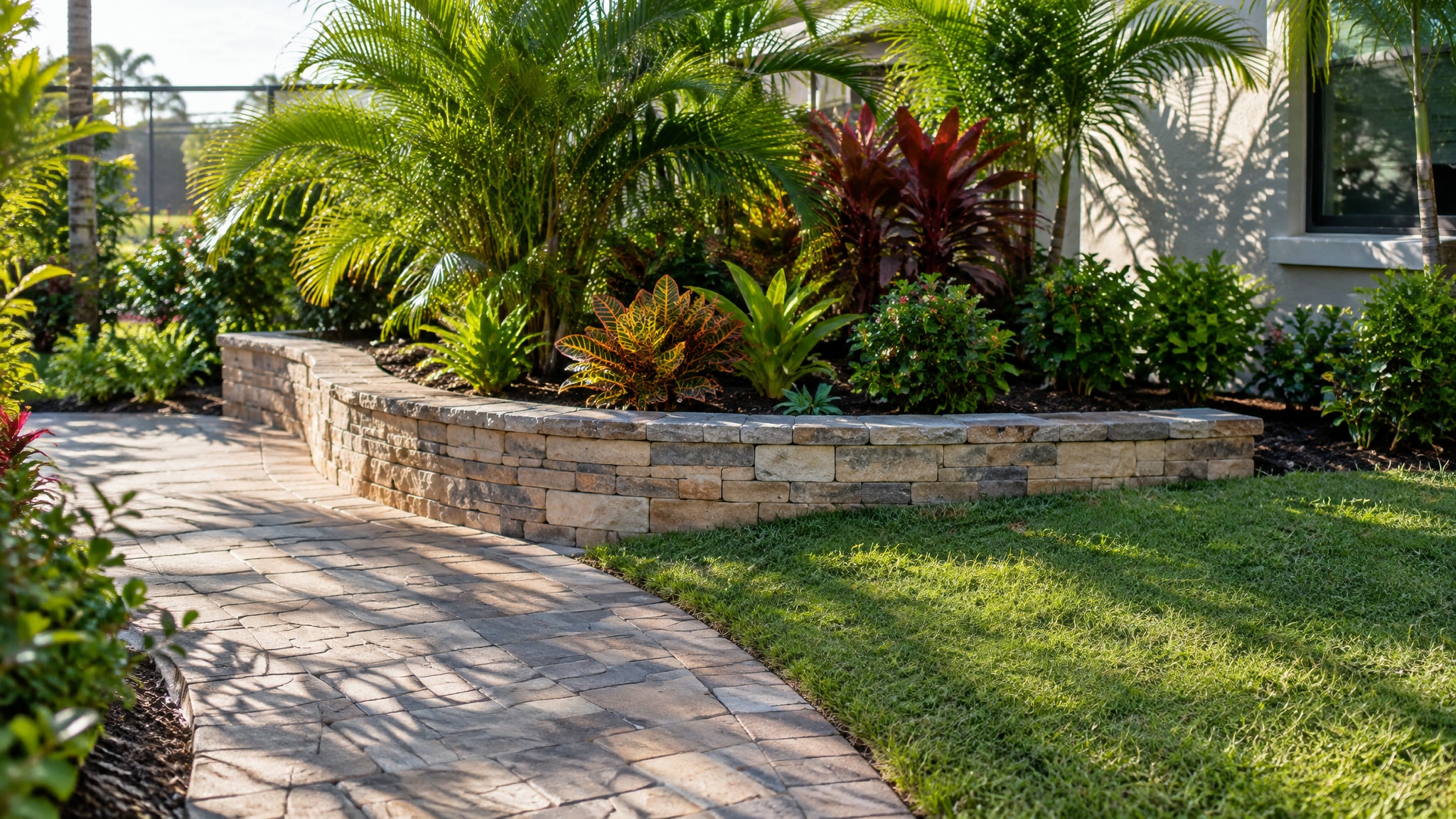
Look at the strips nobody walks on: side yards, the stretch along the street, the corner beyond the patio. Those are the first candidates for beds, paths, or a permeable patio that lets rain soak in instead of running off.
Organic mulch such as pine straw or shredded hardwood is the right cover for those beds. It holds moisture, keeps soil cooler, and breaks down into the soil over time. Gravel and rock do the opposite: they heat up in Florida sun, hold little moisture, and add nothing to the ground beneath them.
For budget questions on conversions, see Cintron's breakdown of landscape renovation costs.
Choosing a Lawn Grass That Needs Less Water
Not every lawn needs to go. If you want to keep some grass, the species matters. Bahiagrass is known for drought tolerance, which makes it a sensible choice for open, sunny areas with minimal care. St. Augustine is shade-tolerant and forms the thick lawn many homeowners expect, but it is thirstier.
Match the grass to the light it gets, and keep the lawn to the area you actually use. The guide to Fort Myers grass types and sod options compares them in more detail.
Florida-Friendly Yard Design Examples That Stay Low Maintenance
These two layouts show how a florida friendly yard design changes with the site. Match yours by sun, drainage, and foot traffic. Neither uses cactus or gravel.
Front Entry Bed for Curb Appeal
Site condition: full sun, well-drained sandy soil, visible from the street.
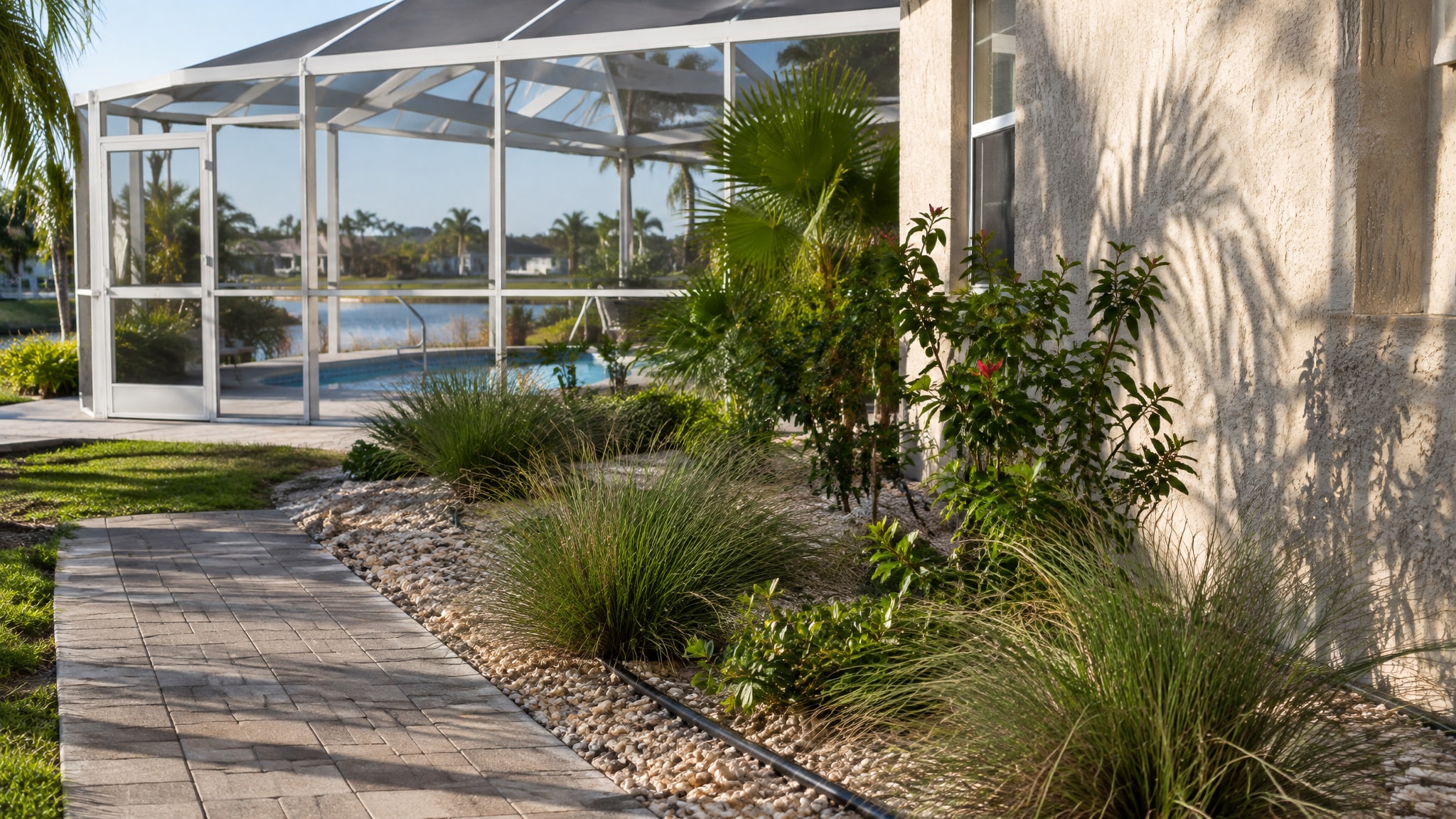
Plan: muhly grass in drifts along the front edge, coontie in the middle layer near the walk, and firebush at the back or corners where it has room to grow. Cover the soil with pine straw.
Upkeep: a light trim of the muhly grass in late winter, occasional shaping of the firebush, and a mulch top-up in spring. Water on a tight schedule while the plants establish, then taper off.
Because all three plants share the same appetite for sun and sharp drainage, they fit on one irrigation zone. That keeps the system simple and the bed looking full from the street.
Side Yard Drainage Swale That Handles Both Seasons
Site condition: a low strip beside the house where summer storm water collects, then dries out hard by spring.
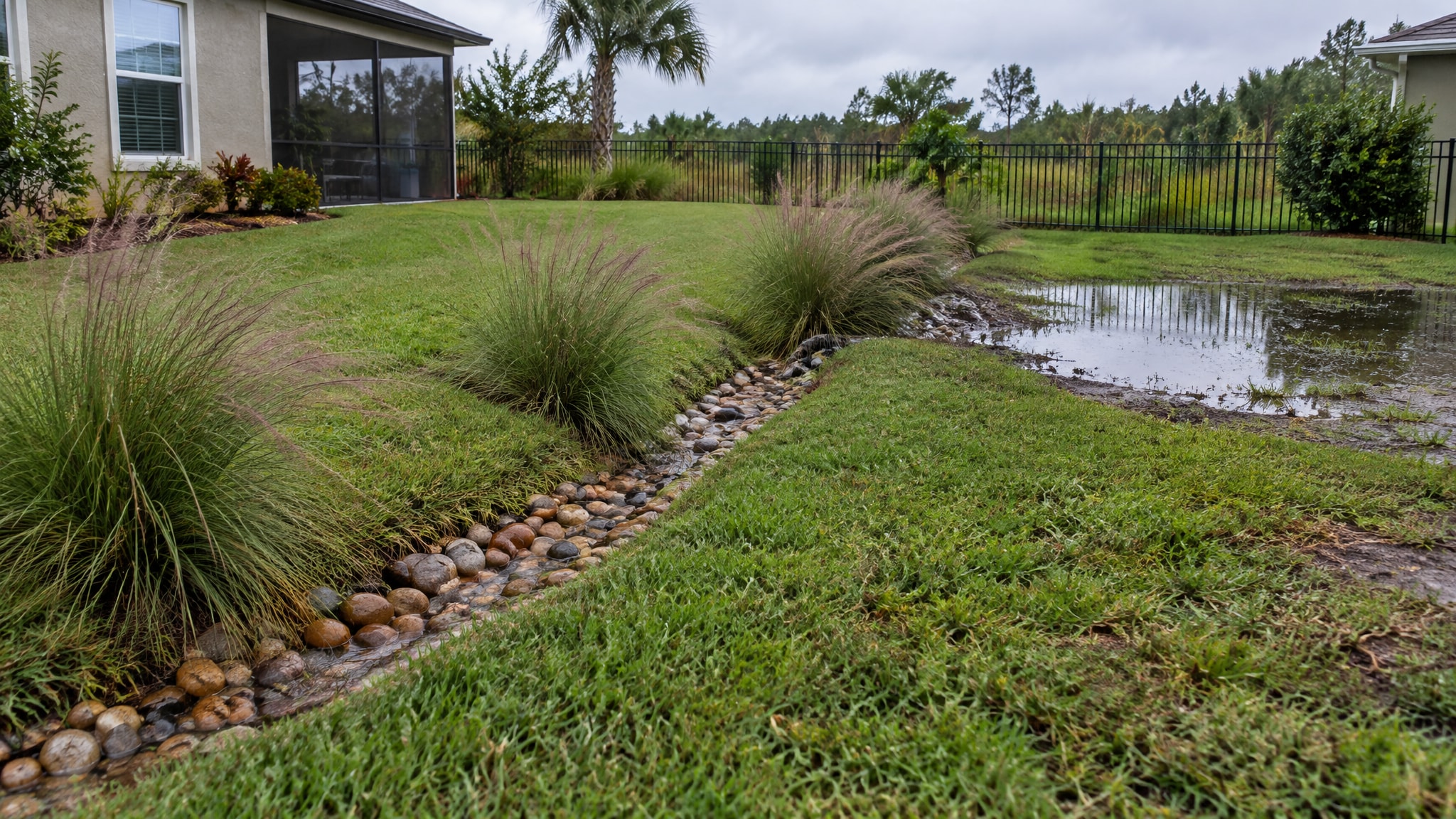
Plan: a shallow, gently graded swale planted with wet-tolerant natives that can take summer flooding and spring drought, such as fakahatchee grass, blue flag iris, and soft rush. Mulch with shredded hardwood, which stays put better than pine straw where water moves.
Upkeep: clear fallen debris after big storms, cut back tired foliage once a year, and refresh the mulch in spring. Once established, the swale needs little supplemental water.
This design works because it treats the problem spot as the planting zone. You are not fighting the water, only giving it somewhere useful to go.
Low-Maintenance Landscaping in Florida: Establishing New Beds
New plantings need regular, deliberate watering through their first months in the ground. After that the schedule tapers as roots establish, so a plan written for the first year will not suit the second.
Timing helps. Fall and early spring are kinder planting windows than summer heat, when young plants stress quickly and storms can flush out fresh beds.
First-Year Watering and a Seasonal Care Calendar
Treat the first year as an investment period. Water new plants often enough that the root ball never dries out, then stretch the gaps between waterings as growth picks up, always within current local watering rules.
Summer: check drainage after storms and clear any low spots or clogged swales.
Fall: plant new beds while the heat eases and the dry season is arriving.
Winter into dry season: deep-water new plantings on a taper, and leave established natives mostly alone.
Spring: refresh mulch to about 2 to 3 inches and trim back grasses and shrubs.
If you would rather not run this calendar yourself, here is what a maintenance package includes.
Plan Your Low-Water Yard With a Fort Myers Landscape Expert
A site check before planting, covering sun, drainage, and irrigation zones, helps you avoid costly replanting. Cintron Landscape Services offers direct phone consultations with a Landscape Expert to start that check.
Call the number listed on the Cintron website during posted business hours and describe your yard: where the water stands, where the sun lands, and what you want to keep. From there, the landscape design and install packages cover the next step.
Cintron Landscape Services, at 7430 Musketeer Lane in Fort Myers, works with homeowners and property owners across Fort Myers, Cape Coral, Estero, Bonita Springs, Sanibel, North Fort Myers, Naples, and Marco Island.
Frequently asked questions
Does xeriscaping mean I never have to water?
No. New plantings need regular watering for their first months, and even established beds benefit from a deep soak during the dry season. The difference is that a well-matched yard needs far less water and less often, within whatever local watering rules apply.
When is the best time to plant a low-water landscape in Fort Myers?
Fall and early spring. Cooler weather lets roots settle before summer heat, and fall planting lines up with the start of the dry season, when you can control watering yourself instead of relying on storms.
Is gravel a good mulch for a water-saving yard in Florida?
Not usually. Gravel and rock heat up in the sun, hold little moisture, and add nothing to the soil. Pine straw or shredded hardwood keeps soil cooler, holds moisture, and improves the ground as it breaks down.
How much does it cost to convert a lawn to a low-maintenance landscape?
Cost depends mainly on how much area changes and what replaces the turf: beds, paths, a permeable patio, or new plantings. Converting only the low-use sections of lawn keeps the project smaller. A Landscape Expert can give you a clearer picture after looking at your site.
Comments