


Hurricane Season Landscaping Preparation: Florida 2026 Guide

Most hurricane damage to a Fort Myers yard comes from things the owner could have fixed in advance. A dead limb hangs over the roof. A swale is choked with leaves. A patio set sits unanchored by the pool.
This guide gives Southwest Florida homeowners and property managers a landscaping checklist built around three jobs: tree trimming, drainage and plant selection. Cintron Landscape Services, based at 7430 Musketeer Lane in Fort Myers, offers phone consultations with a Landscape Expert. Call the number in the contact block on this page during the posted business hours to book a pre-season walk-through or a post-storm assessment, and protect your curb appeal and property value.
Hurricane Season Landscaping Preparation Timeline for Southwest Florida Yards
The Atlantic hurricane season runs from June 1 through November 30, and activity typically peaks in September. Today is October 30, so the 2026 season has about a month left, and the full checklist belongs to the quiet months ahead of June 1, 2027.
That gives you two windows, and they call for different work.
Now through November 30, 2026: urgent fixes only
Remove limbs that are already dead, cracked or hanging over the roof, driveway or power drop.
Clear leaves and debris from swales, inlets and downspout outlets.
Pull mulch back from drain inlets.
Store or anchor loose items whenever a storm is named and tracking toward the Gulf.
December 2026 through May 2027: the full checklist
Schedule structural tree work in the drier months.
Walk the lot during a heavy rain and plan drainage corrections.
Replace weak or poorly placed plants and add new beds.
Test the irrigation rain sensor and reset timers.
Pick a cleanup contact before you need one.
Crews and arborists book up fast once June arrives, and the work is cheaper in the dry months than in a rush after a watch is issued. Owners who would rather not manage this list themselves can ask about landscape maintenance packages in Fort Myers, which can fold pre-season trimming and seasonal checks into a regular schedule.
Tree Trimming Before Hurricane Season: What to Cut and What to Leave
Trimming helps only when it removes the right wood. Done badly, it leaves a tree weaker than the one you started with, so the goal is to cut less and cut smarter.
Remove Dead, Crossing, and Weak Limbs First
Start with the wood most likely to fail. That means dead and diseased limbs, branches that cross and rub, and weak attachments such as tight V-shaped forks where two trunks compete.
Then thin the canopy lightly. A modest reduction in density lets wind move through the crown instead of pushing against it like a sail, and the tree keeps the leaf area it needs to recover.
Plan structural work for late fall through early spring, with a certified arborist. The drier months avoid the flush of soft, fast growth that heavy pruning triggers during summer rains, and that growth tears easily in a storm. For a large tree, check Lee County and city tree-protection rules before anyone takes a saw to it, because removal can require approval.
This is not a job for a pole saw and a free afternoon. Anything near power lines, or any limb you cannot safely cut from the ground, belongs to a licensed professional.
The Cuts That Backfire: Topping and Over-Trimmed Palms
Topping, which means chopping main branches back to stubs, is the cut that makes storm damage worse. Arborist pruning standards, including ANSI A300 and ISA guidance, treat it as an unacceptable practice. The stubs sprout weakly attached shoots, and the wounds invite decay, so the tree ends up more likely to drop limbs than before.
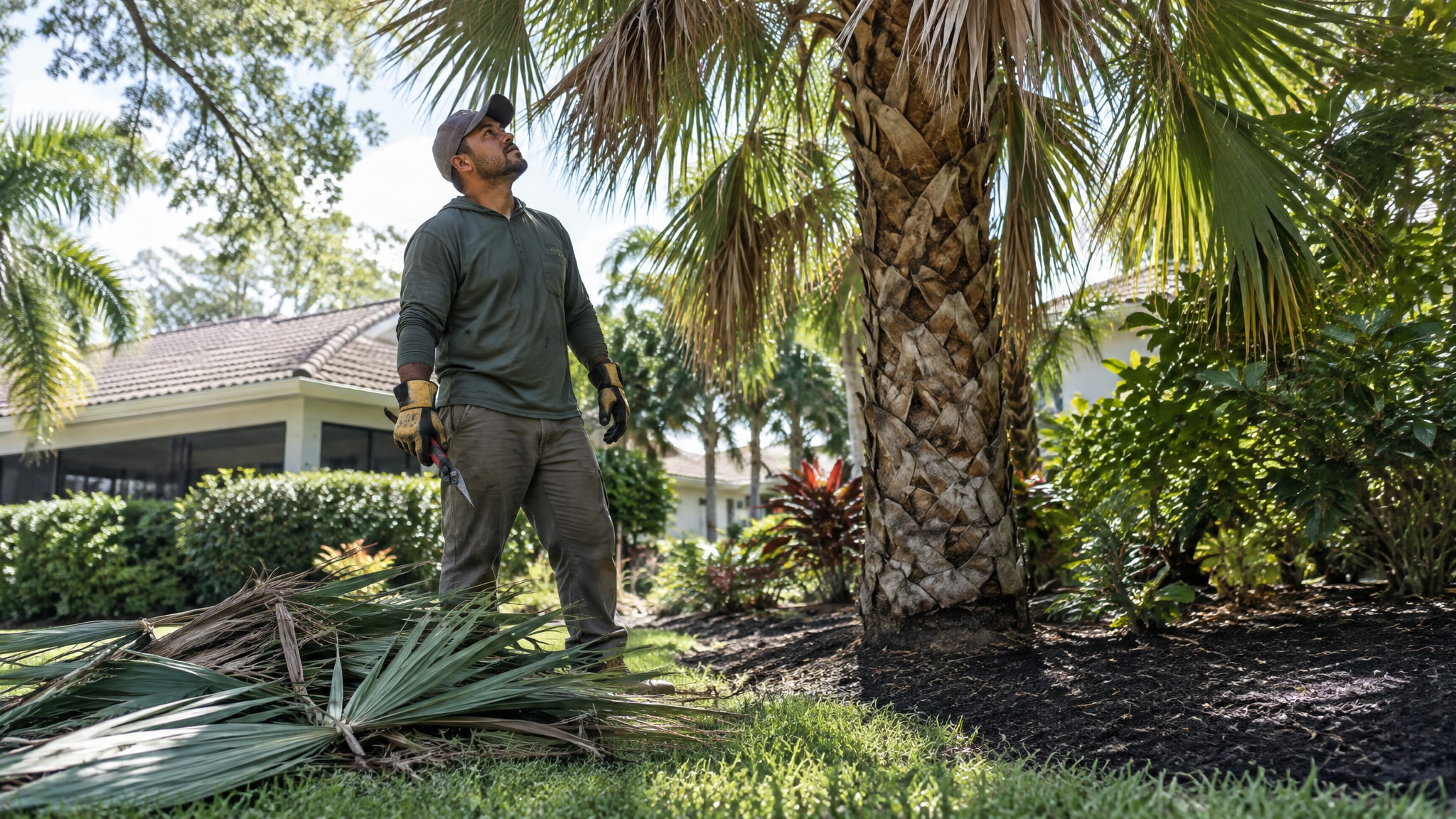
Palms need the opposite restraint. Remove only fronds that are dead or dying. Cutting green fronds up into a "hurricane cut" strips the crown the palm uses to feed itself, and it does nothing to improve wind resistance.
Drainage Solutions for Florida Yards That Hold Water After Heavy Rain
Standing water after a heavy rain is the warning sign. Fort Myers lots are flat and low, so water has few places to go, and a yard that stays soggy for days will flood faster when a tropical system parks overhead.
Walk the Lot During Heavy Rain
Grab a rain jacket and walk the property while it is pouring. You will learn more in twenty minutes than from any plan drawn on a dry day.
Watch three places in particular: along the foundation, in low corners, and where downspouts discharge. Note where water stalls, where it runs toward the house, and where it moves off the lot. Take photos and mark the spots.
Then start with the cheapest fixes.
Clear inlets and swales of leaves, grass clippings and sediment.
Extend downspout outlets so they release water well away from the slab.
Keep mulch and pine straw out of drain inlets.
Rake soil back so the ground slopes away from the foundation.
Permanent Fixes: Swales, French Drains, and Rain Gardens
When the quick fixes are not enough, the permanent options start with grading. Flat Fort Myers lots depend on swales and inlets to carry water off, so reshaping a swale or regrading a low corner often does more than any buried pipe. Confirm with the city or county whether a swale change needs a permit, since swales are often part of the neighborhood's stormwater system and altering one can push water onto a neighbor.
French drains work only when they have somewhere lower to discharge, and many flat lots have no such outlet. Skip the pipe until a surveyor or drainage-savvy designer has confirmed the fall exists.
Rain gardens, planted depressions that hold runoff and let it soak in, suit smaller problems. They are not a cure for a lot that floods under a foot of water. UF/IFAS Florida-Friendly Landscaping guidance, built on principles like right plant, right place and reducing stormwater runoff, applies here directly. Where a grading fix needs a retaining wall or a paved surface, hardscape installation in Fort Myers can be planned around the water path rather than against it.
Plant Selection for Hurricane-Resilient Landscaping in Florida
No Southwest Florida landscape is storm-proof, so "hurricane-resilient" is the honest goal. A resilient yard loses less, recovers faster and puts fewer hazards next to the house. If you plan to replace plants or add beds before June 1, 2027, the right species choice does most of the work.
Choose Wind-Tolerant Florida Species for Your Exposure
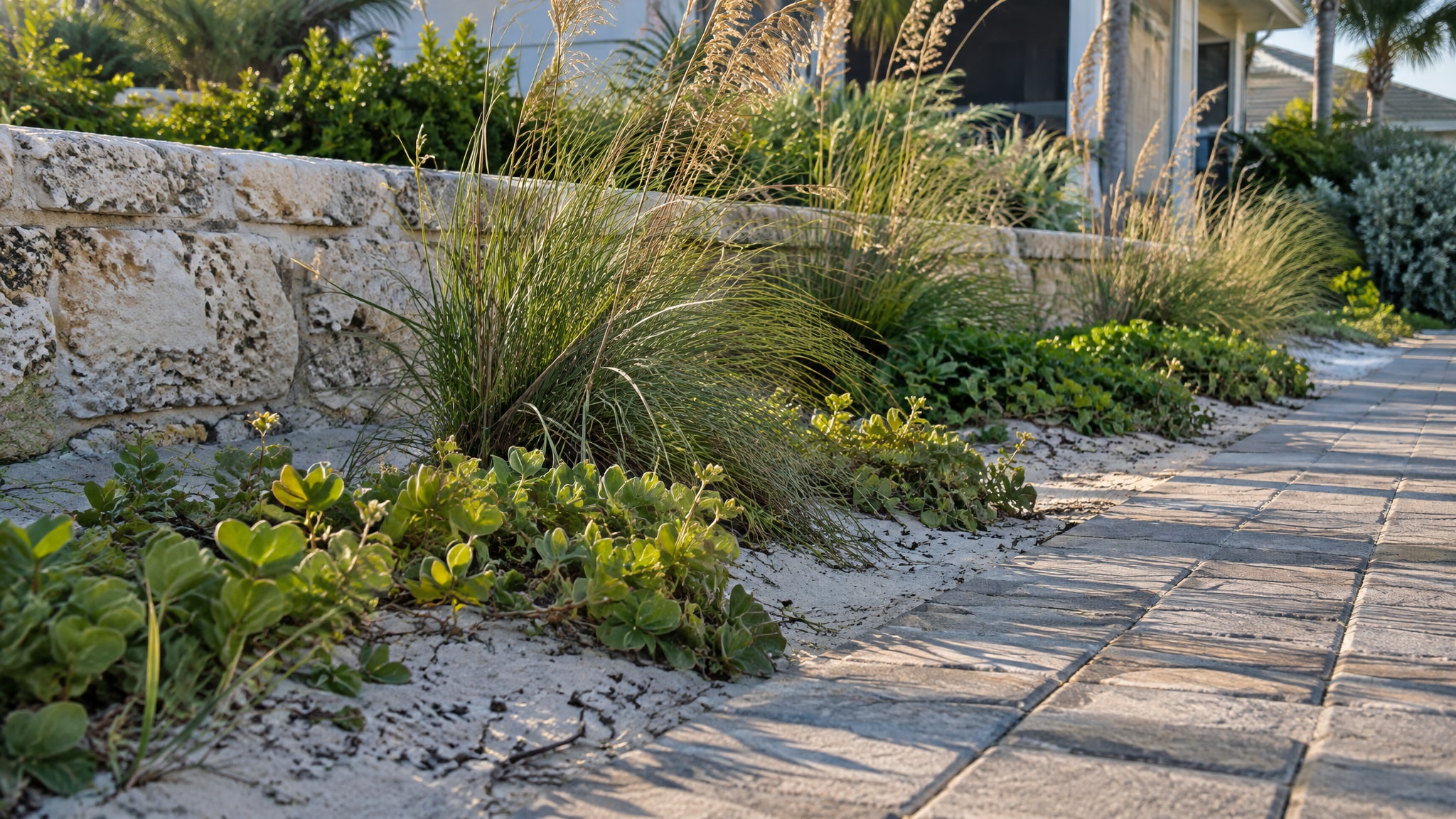
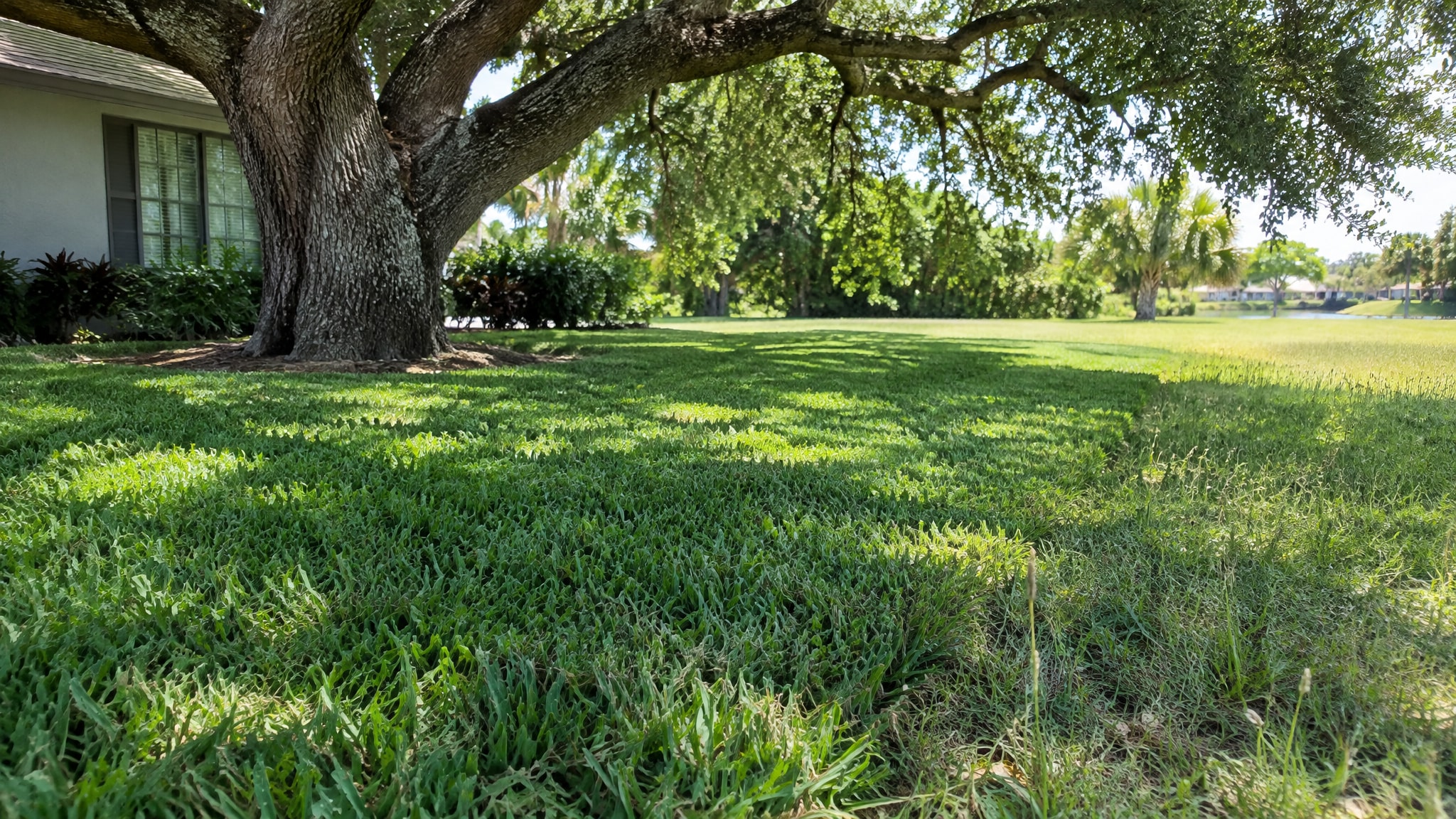
Match the plant to the site. Coastal and canal-front lots take salt spray and strong gusts, so they need salt-tolerant choices such as sea grape. Inland yards have more freedom: cabbage palm (Sabal palmetto) handles wind well, and a large native like live oak can anchor a property if it has room and gets structural pruning that keeps heavy limbs away from the house.
Distance matters as much as species. Even a tough tree can drop a limb, so keep large specimens back from the roof line, the pool cage and the power drop. The Best Plants for Fort Myers Landscaping list is a good next step: Best Plants for Fort Myers Landscaping covers species suited to local soil, salt and heat.
Avoid Shallow-Rooted and Invasive Trees Near the House
Some trees are poor neighbors no matter how they are pruned. Australian pine (Casuarina equisetifolia) has shallow roots, is a Category I invasive on the Florida Exotic Pest Plant Council list, and is widely reported to topple in hurricane winds. Brazilian pepper and melaleuca are also invasives worth removing rather than trimming.
If one of these stands within falling distance of your house, replacing it is a better investment than maintaining it. Check tree-protection rules first, then have a licensed crew handle the removal.
Secure Loose Items and Mulch Before Winds Arrive
Wind turns ordinary yard items into debris, and the damage often comes from your own belongings rather than from the neighbor's tree.
Store or Anchor Anything That Can Become a Projectile
Once a hurricane watch is issued, move or anchor the following:
Patio furniture and umbrellas
Planters and hanging baskets
Decorative stone and loose pavers
Garden tools, hoses and trash bins
Store what you can in a garage or shed. Anything too heavy or awkward to move should be tied down or laid flat. Do this early, because hardware stores run short of supplies once a storm is tracking toward the coast.
Mulch needs attention too, and the job is the opposite of piling it on. Pull mulch and pine straw back from drain inlets so it cannot wash into them and block the flow. Also keep it off the trunk flare, the widening at the base of a tree, where trapped moisture invites rot. Beds that need a reset can be handled by professional mulching services.
Irrigation and Fertilizer Timing Through Storm Season
Water you add to saturated soil does harm, because waterlogged roots lose their grip and stressed plants go down more easily in wind. So pause the irrigation timers when the ground is already wet or a storm is in the forecast, and restart them once the soil dries.
Florida requires a working rain sensor on automatic sprinkler systems, and it is easy to forget until it fails. Test yours by wetting the sensor and confirming the system shuts off. If the sensor is cracked, stuck or missing, or the controller is old, irrigation system installation in Fort Myers is worth pricing before June.
Fertilizer follows its own calendar. State and county rules restrict nitrogen and phosphorus fertilizer during the summer rainy season, because heavy rain carries it off the lawn and into canals and the Gulf. Check the current Lee County or city ordinance for exact dates, and feed your lawn outside that window.
Fertilizer rules do not make a storm-ready yard on their own. They protect water quality, and the timing helps you avoid forcing soft growth right before peak season.
Storm Damage Landscape Cleanup: Safety, Documentation, and Who to Call
Storm damage landscape cleanup has a fixed order: safety, then documentation, then repair. Rushing the order is how people get hurt or lose a claim.
Safety First: Downed Lines and Leaning Trees
Treat every downed line as live. Keep people and pets well clear, and call the utility. Do the same with leaning trees and hanging limbs, which can drop without warning. Leave them to the utility or a licensed arborist, and do not cut under tension yourself.
When the area is safe, photograph the damage before anything is moved. Wide shots and close-ups of fallen trees, damaged fences, flooded beds and roof contact give you a record for insurance.
Then hire carefully. Confirm any crew carries licensing and liability insurance before they start, and be wary of anyone who knocks on doors after a storm and asks for cash upfront. If flooding or surge has killed turf, sod installation in Fort Myers can restore the lawn once debris is cleared and the soil has drained.
Cintron Landscape Services serves Fort Myers, Cape Coral, Estero, Bonita Springs, Sanibel, North Fort Myers, Naples and Marco Island. For a pre-season walk-through or a post-storm assessment, call the number in the contact block on this page during business hours and ask for a Landscape Expert.
Frequently asked questions
Is it too late to prepare my Fort Myers yard in late October?
No, but narrow the job. The 2026 season runs through November 30, so clear dead limbs, swales, inlets and loose items now. Save structural pruning, drainage regrading and new plantings for December through May, ahead of June 1, 2027.
Should I trim my trees right before a hurricane arrives?
No. A last-minute trim rarely helps and can leave fresh wounds and debris piles that blow around. Remove only dead or hanging limbs if you can do so safely. Do real structural work in the drier months with a certified arborist.
Can I make my yard hurricane-proof?
No. No Southwest Florida landscape is storm-proof. You can make it more resilient by trimming properly, moving water away from the house, choosing wind-tolerant species for your exposure and keeping loose items secured.
Do I need a permit to change a swale or remove a large tree?
You may. Swales are often part of a neighborhood's stormwater system, and large trees can be covered by local tree-protection rules. Confirm with your city or county before you regrade or remove anything.
What should I do first after a storm damages my landscaping?
Stay clear of downed power lines and leaning or hanging limbs, and call the utility or a licensed arborist. Once the area is safe, photograph the damage before cleanup. Then hire licensed, insured help for removal and repairs.
Comments